Maruti Suzuki’s Best-Selling Fronx Fails Australia–New Zealand Crash Tests
ANCAP awards just one star after rare seatbelt failure, raises safety concerns for rear-seat passengers

Business News:
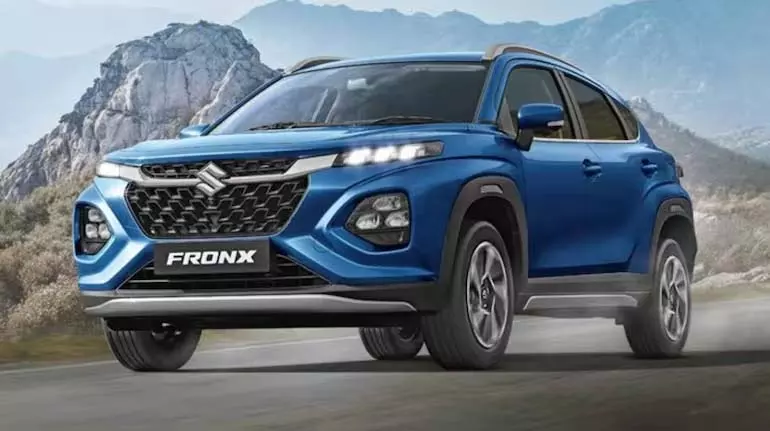
Maruti Suzuki India’s popular compact SUV, the Fronx, has received a disappointing one-star safety rating in crash tests conducted by the Australian New Car Assessment Program (ANCAP).
The Suzuki Fronx was launched in New Zealand in June 2025 and in Australia in August 2025. During the crash testing process, ANCAP identified a seatbelt failure in the vehicle—an issue the agency described as “rare and serious.” Following this, ANCAP informed vehicle safety regulators in both Australia and New Zealand.
ANCAP stated that until the cause of the failure is identified and necessary corrective actions are implemented, adults and children should not travel in the rear seats of the Suzuki Fronx.
According to the report, the one-star rating reflects the Fronx’s overall crash performance, particularly concerns related to its structural integrity and safety systems. Around 1,300 Fronx units have already been sold in Australia, while approximately 1,000 units have been sold in New Zealand.
At the time of publishing this article, Maruti Suzuki India had not responded to an email seeking comment. ANCAP noted that the Fronx rating report was published in December, although the exact date of testing was not specified.
Launched in 2023, the Fronx is among Maruti Suzuki India’s best-selling models in the domestic market. Between January and November 2025, more than 1.6 lakh units were sold, averaging about 14,500 units per month and accounting for nearly 10 percent of the company’s total sales.
Notably, the version of the Fronx sold in India has not yet been tested by Global NCAP or BNCAP (Bharat New Car Assessment Program), both of which provide rating-based safety evaluations for vehicles sold in India.
Other Global NCAP Test Results
In a separate announcement, Global NCAP conducted crash tests on the Maruti Suzuki Celerio and Ciaz under its “Safer Cars for India” programme. The six-airbag variant of the Celerio hatchback scored three stars for adult occupant protection—an improvement over its previous two-star rating.
The Ciaz, however, performed poorly, securing only a one-star rating for adult occupant safety. The test revealed the absence of side head protection, while the sedan’s footwell and bodyshell were rated as unstable.
Commenting on the results, Global NCAP CEO Richard Woods said, “We welcome Maruti Suzuki’s commitment to improving safety with five-star performance in newer models like the Dzire and Vitara, but it is disappointing to see some older models lagging behind.”