India Accounts for the Largest Share of Global Digital Transactions: Amit Shah
CBDC-Based Public Distribution System Launched in Gandhinagar

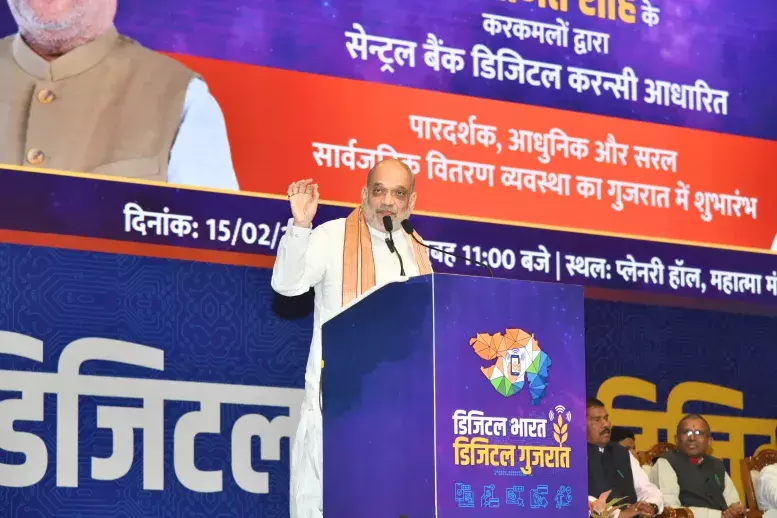
Gandhinagar: Union Home Minister Amit Shah on Sunday said that more than half of the world’s total digital transactions now take place in India. He made the remarks while launching the country’s first Central Bank Digital Currency (CBDC)-based Public Distribution System (PDS) in Gandhinagar, Gujarat.
Speaking at a function held at Mahatma Mandir, Shah highlighted India’s rapid digital transformation over the past decade, stating that it has enabled the government to integrate advanced technology into welfare delivery systems.
Extending greetings on the occasion of Mahashivratri, he said, “A decade ago, nearly 600 million people in the country did not have bank accounts. Today, India leads the world in digital transactions, with more than half of global digital transactions happening here.”
Shah inaugurated a transparent and technology-driven PDS based on CBDC, integrated with Aadhaar-based biometric authentication and the payment system of the Reserve Bank of India. He said the initiative would eliminate leakages in the distribution of subsidised food grains.
“Technology-based systems like CBDC will completely remove corruption and the role of middlemen,” Shah stated, adding that the model will be implemented across the country within the next three to four years.
During the programme, an ‘Annapurti’ grain ATM was launched in Ahmedabad’s Sabarmati zone. The machine can dispense 25 kilograms of grain within 35 seconds with precise measurement of weight, price, and quality.
Under the ‘Garima Poshan – Suposhit Garudeshwar Taluka’ campaign, distribution of one-kilogram sealed packets of chana and arhar dal was also initiated.
Shah further said that under the Pradhan Mantri Garib Kalyan Anna Yojana, 810 million people are receiving free ration, and digitisation will make the system even more transparent.
He also highlighted major welfare initiatives undertaken in the last decade. Under the Pradhan Mantri Awas Yojana, four crore houses have been constructed. Additionally, tap water connections have been provided to 13 crore households, nearly 13 crore homes have received LPG gas cylinders, and toilets have been built in 12 crore households.
Shah added that 2.91 crore women have become ‘Lakhpati Didis’, reflecting the government’s inclusive development efforts.
Gujarat Chief Minister Bhupendra Patel said that the integration of Jan Dhan accounts, Aadhaar, and mobile connectivity has ensured direct benefit transfers to the rightful beneficiaries. He noted that the grain ATM would operate round the clock, allowing beneficiaries under the National Food Security Act to collect wheat, rice, and pulses at their convenience.
“Under the CBDC system, digital tokens will provide accurate information about subsidies, quantity, and price, ensuring complete transparency,” he said.
Union Food and Public Distribution Minister Pralhad Joshi stated that the initiative aims to safeguard the rights of nearly 800 million beneficiaries. He said that digitisation of ration cards has enabled the ‘One Nation, One Ration Card’ framework, allowing beneficiaries to access food grains by scanning QR codes at grain ATMs or through SMS-based OTP verification.
“With the implementation of this technology, around two to three crore fake ration cards have been cancelled,” he added, noting that the digital amount credited to beneficiaries’ wallets can only be used to purchase subsidised food grains.
Deputy Chief Minister Harsh Sanghavi said the new system would reduce queues at ration shops and allow beneficiaries to collect food grains anytime. “There will not be even a one-gram difference in weight,” he asserted.
During the event, memorandums of understanding were signed between the Food and Civil Supplies Department and the Consumer Education and Research Centre to establish a pre-litigation grievance redressal system. Separate agreements were also signed with CARE Ratings and the Consumer Education and Research Centre to develop a Consumer Responsibility Index aimed at strengthening accountability in the Public Distribution System.