Impact of Civil Unrest in Iran: Indian Basmati Rice Exports Under Strain, Payments Delayed
Domestic prices fall sharply as exporters face uncertainty, delayed settlements, and rising risk

New Delhi:
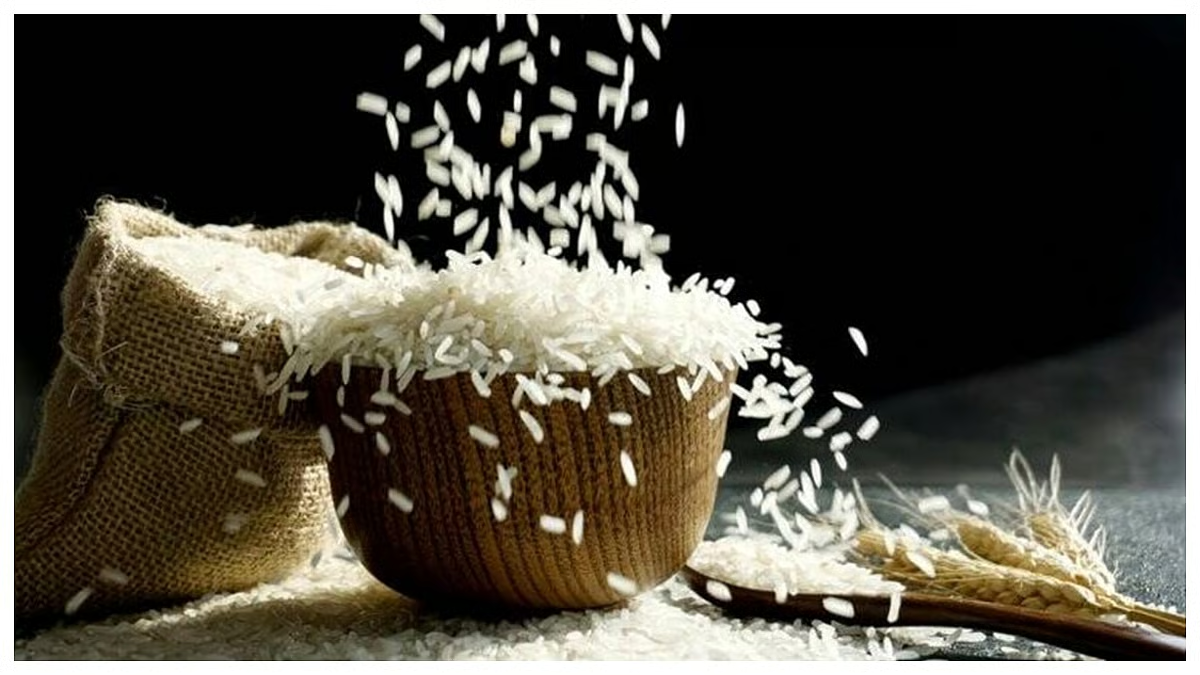
Impact of Civil Unrest in Iran:The impact of civil unrest in Iran has begun to affect India’s basmati rice exports, leading to a sharp fall in domestic prices as exporters grapple with delayed payments and growing uncertainty, an industry body said on Tuesday. The Indian Rice Exporters Federation (IREF) urged exporters to reassess risks associated with Iranian contracts, adopt secured payment mechanisms, and avoid over-leveraging inventories meant for the Iranian market.
Impact of Civil Unrest in Iran:Trade data show that during April–November of FY 2025–26, India exported 5.99 lakh tonnes of basmati rice to Iran, valued at USD 468.10 million. Iran remains India’s top destination for basmati rice exports. However, ongoing instability in the current financial year has put pressure on order flows, payment cycles, and shipment schedules. The impact is now clearly visible in domestic mandis.
Over the past week alone, prices of key basmati varieties have dropped sharply, reflecting buyer hesitation, contract delays, and heightened risk perception among exporters. The domestic price of Basmati 1121 fell from ₹85 per kg to ₹80 per kg, while Basmati 1509 and 1718 declined from ₹70 per kg to ₹65 per kg.
IREF National President Prem Garg said in a statement, “Iran has long been a crucial market for Indian basmati. However, the current internal turmoil has disrupted trade channels, slowed payments, and weakened buyer confidence.”
Impact of Civil Unrest in Iran:He cautioned exporters to exercise extreme prudence, particularly regarding credit exposure and shipment timelines. The federation noted that importers have expressed their inability to meet existing commitments and remit payments to India, adding to uncertainty for exporters.
IREF has issued an advisory urging stakeholders to diversify shipments to alternative markets in West Asia, Africa, and Europe to mitigate the impact of any prolonged slowdown in Iran-bound exports.
“We are not sounding an alarm, but advising caution,” Garg said. “During times of geopolitical and internal instability, trade is often the first casualty. A well-thought-out approach is essential to protect both exporters and farmers.”
The federation also expressed concern over recent remarks by US President Donald Trump, who indicated that countries continuing trade with Iran could face a 25% tariff. IREF clarified that Indian rice exports to the US already attract a 50% tariff, up from 10% earlier. Despite this, exports to the US have remained strong.
Impact of Civil Unrest in Iran:India exported 240,518 tonnes of basmati and non-basmati rice to the US during April–November 2025–26, compared with 235,554 tonnes in the entire FY 2024–25. The US is India’s 10th-largest global market for rice and the fourth-largest for basmati rice.
The federation noted that it remains unclear whether the proposed 25% tariff would be imposed over and above the existing 50% duty. It added that given Indian basmati’s strong positioning in global markets, even higher tariffs are unlikely to cause a major drop in exports.
However, IREF remains more concerned about developments in Iran, where disruptions in the local market have affected trade settlements. Importers’ inability to fulfill commitments and remit payments has deepened uncertainty. While similar crises have occurred in the past, the federation said the path forward remains unclear, and further volatility in prices, liquidity, and trade sentiment is expected in the coming weeks.