Jharkhand Presents ₹1.58 Lakh Crore ‘Abua Dishom’ Budget; Alleges Reduced Central Assistance

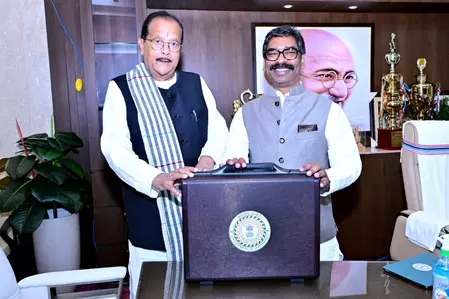
Ranchi: The Jharkhand government on Tuesday presented a ₹1,58,560 crore budget for the financial year 2026–27 in the Assembly. State Finance Minister Radhakrishna Kishore termed it the “Abua Dishom Budget,” describing it as inclusive, sustainable, and focused on welfare-driven development under the leadership of Chief Minister Hemant Soren.
The minister said the budget reflects the government’s commitment to wipe the tears of the poor and bring smiles to every citizen. Calling it a step toward realizing the vision of “Abua Jharkhand” (Our Jharkhand), he stated that the government aims to ensure development reaches the last person in the state.
Budget Size Up by 9%, Focus on Welfare
The previous budget for 2025–26 stood at ₹1,45,400 crore. This year’s outlay marks an increase of nearly 9 percent. The government has prioritized social welfare, agriculture, women empowerment, and infrastructure development.
During his speech, Kishore accused the central government of reducing financial support to the state. He alleged that Jharkhand received nearly ₹16,000 crore less under tax devolution and grants, including around ₹5,000 crore in tax share and ₹11,000 crore in grants. He further claimed that GST rate rationalization is causing an annual loss of about ₹4,000 crore to the state. The implementation of the 60:40 funding ratio under MGNREGA has allegedly imposed an additional burden of ₹5,640 crore on Jharkhand. He also mentioned pending dues of ₹1.36 lakh crore from coal companies.
Despite these challenges, the minister said the government has not delayed employees’ salaries and has allocated ₹13,000 crore for the Chief Minister Maiyan Samman Yojana. The state’s own revenue is projected to rise from ₹25,521 crore in 2019–20 to ₹66,700 crore in 2026–27.
Major Allocations for Women, Health and Social Security
Under the Chief Minister Maiyan Samman Yojana, women aged 18 to 50 years will receive ₹2,500 per month, with a budget allocation of ₹14,065.57 crore. An amount of ₹3,517.23 crore has been earmarked for the Universal Pension Scheme, and ₹1,463.58 crore for national pension schemes. The total budget for the Women and Child Development Department stands at ₹22,995.69 crore.
The health sector has been allocated ₹7,990.30 crore. The government has announced a special ₹200 crore cancer treatment initiative and set a target to open 750 “Abua Dawakhana” health centers.
Agriculture, Rural Development and Infrastructure Push
To strengthen agriculture, the allocation for the Birsa Seed Production Scheme has been increased to ₹145 crore. Soil and water conservation schemes will receive ₹475.50 crore, ₹75 crore has been earmarked for solar-powered irrigation, and ₹80 crore for farm equipment distribution. Crop insurance will see an expenditure of ₹400 crore.
For rural development, ₹12,346.90 crore has been allocated, including ₹4,100 crore under the “Abua Awas Yojana.” Additionally, ₹66 crore will be spent on promoting products made by self-help groups under the “Palash” brand.
Education and Fiscal Indicators
In the education sector, ₹16,251.43 crore has been allocated for elementary and secondary education, while higher and technical education will receive ₹2,564.45 crore. The government has also announced a push for model schools and digital learning initiatives.
Out of the total budget, ₹1,20,851.90 crore has been earmarked for revenue expenditure and ₹37,708.10 crore for capital expenditure. Capital spending has been increased by 8.5 percent, which is expected to accelerate road, irrigation, power, and drinking water projects.
The fiscal deficit is estimated at ₹13,595.96 crore, equivalent to 2.18 percent of the Gross State Domestic Product (GSDP), while the debt-to-GSDP ratio has been pegged at 25.3 percent.