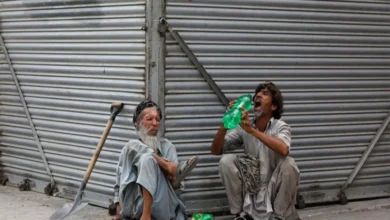
Pakistan’s Economic Mismanagement Pushes Poverty and Inequality to Record Highs
Government Survey Reveals Sharp Rise in Poverty, Joblessness and Income Gaps

Islamabad: Poverty in Pakistan has surged to 29 percent—its highest level in 11 years—while income inequality has climbed to its worst point in nearly three decades, exposing deep flaws in the country’s economic management.
According to a government survey reported by The Express Tribune, nearly 70 million Pakistanis are now living below the monthly poverty line of 8,484 Pakistani rupees. Preliminary results for fiscal year 2024–25 show that poverty has increased by 32 percent compared to 2018–19, when the previous survey was conducted.
In 2019, the poverty rate stood at 21.9 percent. It has now risen to 28.9 percent—the highest level since 2014. Meanwhile, income inequality has widened to 32.7, marking its highest level since 1998. Rural communities have been hit particularly hard by the crisis.
In rural areas, poverty has jumped from 28.2 percent to 36.2 percent, while in urban centers it has increased from 11 percent to 17.4 percent.
Provincial data paints an equally troubling picture:
-
In Punjab, poverty has risen from 16.5 percent to 23.3 percent.
-
In Sindh, it has climbed from 24.5 percent to 32.6 percent.
-
In Khyber Pakhtunkhwa, the rate has increased from 28.7 percent to 35.3 percent.
-
In Balochistan, already the poorest province, poverty has surged from 42 percent to 47 percent.
Security concerns and limited access to markets have further worsened conditions in Khyber Pakhtunkhwa and Balochistan.
The report also revealed a 12 percent decline in real household income over the past seven years. Although nominal incomes have increased, inflation has outpaced earnings, significantly eroding purchasing power. Real household expenditure has fallen by 5.4 percent, highlighting mounting financial pressure on families.
Unemployment has risen to 7.1 percent—the highest in 21 years—while large-scale manufacturing remains below pre-pandemic levels.
Planning Minister Ahsan Iqbal acknowledged that stabilization measures backed by the International Monetary Fund (IMF)—including subsidy cuts, currency devaluation, higher energy prices, and increased taxation—have intensified inflationary pressures. However, he emphasized that reversing the trend requires long-term growth and wealth creation rather than relying solely on cash transfers.
Despite claims of macroeconomic stabilization, the data points to a harsh reality: millions of Pakistanis are bearing the cost of years of policy missteps and stalled structural reforms, as highlighted by The Express Tribune.