Rupee Hits Record Low Of 91.01 Against Dollar, Government Reveals What’s Really Pushing The Currency Down


New Delhi: For the past few weeks, everyone-from common people to investors-has been asking one question: why has the Indian rupee fallen so sharply?
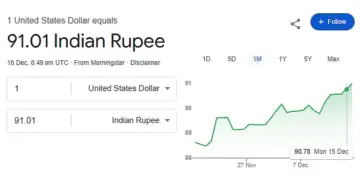
The rupee has slipped close 91 against the US dollar, and because of this sharp fall, the issue was raised in Parliament. The government clearly explained in the Lok Sabha that the rupee’s weakness is not sudden and has happened due to several domestic and global reasons.
 How fast did the rupee slide?
The government said that in the third week of November 2025, the rupee fell to 89.41 per dollar. In early December, it weakened further to 89.64, crossed 90.42 on December 4, and by December 16, 2025, it was trading close to 91 per dollar.
Dollar demand and global uncertainty
One major reason for the rupee’s fall is the strong demand for dollars in the domestic forex market. When stock markets in India and abroad fall, investors move their money to safer assets like the US dollar. Global trade uncertainty has also increased pressure on the rupee.
No fixed level for the rupee
The government clarified that India does not fix the rupee at any specific level. Neither the government nor the Reserve Bank of India (RBI) sets a target price for the rupee. The currency moves based on market forces, though RBI intervenes when volatility becomes excessive.
Other factors hurting the rupee
The government listed several additional reasons for the rupee’s weakness. These include a strong dollar index, foreign investment outflows, high crude oil prices, global interest rate conditions, and concerns over the current account deficit. In FY26, a rising trade deficit and uncertainty around trade agreements with the US also affected sentiment.
Steps taken by RBI
To stabilise the rupee, RBI has taken multiple steps. It extended the export credit period to support dollar inflows, relaxed forex rules for merchant trade, and made rupee-based trade easier with neighbouring countries. RBI also allowed funds in special rupee vostro accounts to be invested in government bonds.
RBI’s market intervention
The government said that over the past year, RBI has both sold and bought dollars whenever needed. These actions were taken to reduce sharp movements and maintain stability in the currency market.
Long-term rupee movement
Looking at the long term, the government noted that the rupee was around 63 per dollar in December 2014 and has weakened to around 90 by December 2025, showing a gradual decline over 11 years.
Is a weak rupee always bad?
The government said a weaker rupee is not entirely negative. It helps exporters because Indian goods become cheaper overseas. However, imports become costlier, which can add to inflation.
Government’s reassurance
The government assured Parliament that India’s economic fundamentals remain strong. Domestic demand is stable, inflation is under control, corporate balance sheets have improved, and financial discipline remains intact. Both the government and RBI are closely monitoring the situation.