PM Modi to Visit Somnath Temple on May 11
‘Somnath Swabhiman Parv’ Marks 1,000 Years Since First Attack and 75 Years of Temple Reopening

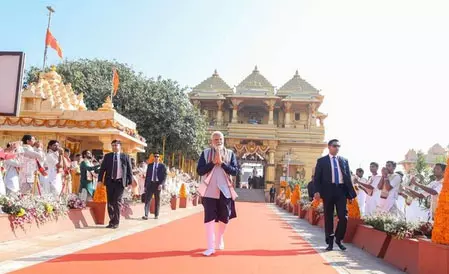
Gujarat: The historic Somnath Temple, regarded as an eternal symbol of faith, courage, and Indian civilization, is once again in the spotlight. This year, a special celebration titled “Somnath Swabhiman Parv” is being organized to commemorate 1,000 years since the first attack on the temple and 75 years since its reconstruction and reopening. On this occasion, Prime Minister Narendra Modi will visit the Somnath Temple on May 11.
Located at Prabhas Patan on the Saurashtra coast of Gujarat, the Somnath Temple is considered the first and holiest among the 12 Jyotirlingas of Lord Shiva. Mentioned in the Shiva Purana, the temple is a major center for the worship of Lord Shiva, Lord Krishna, and Shakti. Somnath is also given the foremost place in the Dwadash Jyotirlinga Stotra, highlighting its supreme importance in India’s spiritual and cultural heritage.
The history of Somnath Temple is an extraordinary saga of destruction and revival. The temple faced its first major attack in 1026. From the 11th to the 18th century, it was repeatedly attacked and looted, but every time, devotees and rulers rebuilt it. In the 12th century, King Kumarapala reconstructed the temple. Later, the rulers of Junagadh and Maratha queen Ahilyabai Holkar of Indore also played significant roles in restoring and preserving the temple’s legacy.
After India’s independence, Iron Man Sardar Vallabhbhai Patel visited the ruins of Somnath in 1947 and resolved to rebuild it. He believed that the reconstruction of Somnath would restore India’s cultural confidence. With public participation and national determination, the present temple was constructed in the Kailash Mahameru Prasad architectural style. On May 11, 1951, India’s first President Dr. Rajendra Prasad formally inaugurated the rebuilt temple.
Even after 75 years, Somnath continues to stand as a symbol of India’s faith, pride, and spiritual strength. The story of Somnath is not limited to the temple alone but also honors the warriors who sacrificed their lives to protect it. Among them, Veer Hamirji Gohil holds a special place. It is believed that during Zafar Khan’s attack in 1299, he laid down his life defending the temple.
The “Somnath Swabhiman Parv” celebrates India’s unshakable faith and cultural resurgence. While the event recalls the first attack of 1026, it also symbolizes India’s cultural rebirth through the temple’s reopening in 1951.
Prime Minister Narendra Modi, who is also the chairman of the Somnath Trust, has described the temple as a symbol of India’s “invincible spirit.” Under the slogan “Vikas Bhi, Virasat Bhi” (Development as well as Heritage), he announced special prayers at Somnath for the next 1,000 days and appealed to people to visit the temple during this historic period.
Earlier in January 2026, PM Modi also participated in the Somnath Swabhiman Parv, during which the Omkar mantra was chanted continuously for 72 hours and special prayers were offered for the nation’s prosperity. A grand Shaurya Yatra featuring 108 horses was also organized at Prabhas Patan in honor of the warriors who protected the temple.
On April 30, 2026, a special train was flagged off from Safdarjung Railway Station in Delhi under the “Chalo Chalen Somnath” campaign. More than 1,300 devotees participated in the journey. The train reached Somnath on May 1, where aarti ceremonies, cultural events, and a light-and-sound show were organized.
Situated along the Arabian Sea, the magnificent temple features a 150-foot-high shikhara topped with a 10-ton kalash. The temple complex is adorned with 1,666 golden urns and 14,200 flags, adding to its grandeur. Every year, nearly 9.2 to 9.7 million devotees visit Somnath for दर्शन.
The Somnath Trust is not limited to religious activities alone but is also actively involved in education, healthcare, women’s empowerment, and environmental conservation. The trust runs computer education, tailoring, digital literacy, and employment training programs for rural youth and women. Initiatives like “School on Wheels” are helping bring digital education to villages.
During the COVID-19 pandemic, the trust contributed ₹8.73 crore during the first wave and ₹2.21 crore during the second wave. It also donated ₹1 crore to the Chief Minister’s Relief Fund and provided oxygen plants, medical assistance, and ration supplies to needy families.
Somnath was declared a “Swachh Iconic Place” in 2018. Vermicompost is made from temple flowers, plastic waste is converted into power blocks, and nearly 30 lakh liters of water are recycled every month. A Miyawaki forest with 7,200 trees absorbs nearly 93,000 kilograms of carbon dioxide annually.
Somnath has also emerged as a model for women’s empowerment. Out of the temple trust’s 906 employees, 262 are women. From managing Bilva forests to distributing prasad and serving food, women play a key role in temple operations. A total of 363 women have received direct employment opportunities, with an annual combined income of nearly ₹9 crore.