Bihar Election Results 2025: Meet Bihars New Caste? The Hidden Coalition That Helped Nitish Kumar Secure NDAs 200-Plus Surge

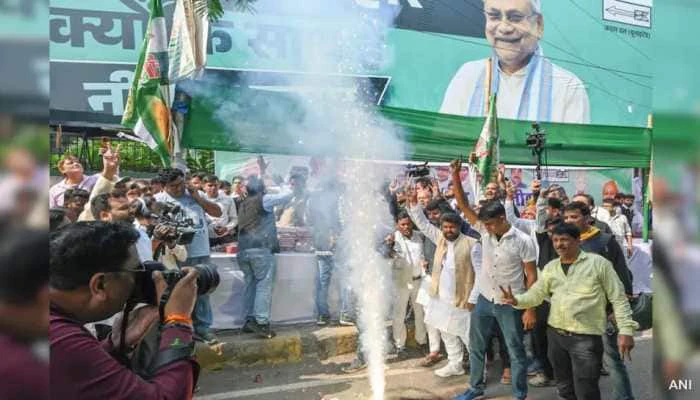
Bihar Election Results 2025: Welfare schemes seems to have become the new caste of Bihar, altering political loyalty with a certainty that old social blocs can no longer command.
The 2025 election results have made that shift impossible to ignore.
From the Mukhyamantri Mahila Rozgar Yojana and Lakhpati Didi initiative to Jeevika self-help groups, the Balika Cycle Yojana, reservation for women, housing assistance, old-age pensions and health-support guarantees, Chief Minister Nitish Kumars long chain of social-support programmes has evolved into a daily lifeline for millions.
For families who depend on these benefits to keep kitchens running, repay small debts, push daughters to school or survive sudden medical emergencies, voting was not a matter of caste identity anymore; it was a vote for continuity of survival.
The story of Bihar election results cannot be understood through electoral arithmetic alone. What unfolded across the state was the consolidation of a welfare-dependent voter base that has been built, layer by layer, through almost two decades of Nitishs governance. These schemes did not arrive as pre-election gifts. They seeped into households slowly, often turning into the only dependable institutional support many families could count on. By the time votes were cast this year, the benefits were no longer schemes in the eyes of voters, they had become rights.
This is why the first shock of polling day was not the surge in turnout but who had decided to show up in record numbers. From Chapra to Supaul, long queues began forming before sunrise and observers noticed a pattern: welfare beneficiaries were turning up early, many arriving in groups from the same self-help circles or neighbourhood clusters.
The Election Commission later confirmed what political workers already sensed, the womens turnout had touched a historic 71.6%, significantly higher than the 62.8% turnout among men.
But the turnout was only the visible part. The consolidation had begun much earlier.
Inside Nitishs Welfare Web That Cemented Bihars 2025 Mandate
Nitishs political strength in 2025 did not come from speeches or alliances; it came from the imprint his policies have made on everyday life. The Mukhyamantri Mahila Rozgar Yojana, where Rs 10,000 was transferred to women to help them start income-generating work, with a promise of Rs 2 lakh for those who showed productive use, reached households that had never previously interacted with the banking system.
Parallelly, the Lakhpati Didi programme nurtured women-led microbusinesses with training, capital support and mentorship. Jeevika self-help groups expanded their footprint steadily, turning rural women into borrowers, savers and entrepreneurs.
Once dismissed as a small idea, the Balika Cycle Yojana transformed mobility and altered school attendance patterns. Add to this the long-standing reservation for women in panchayats and police recruitment and the network of safety, dignity and opportunity expanded in ways that traditional caste coalitions could not.
Each initiative functioned like a thread woven into a thicker social fabric. Over time, that fabric became Nitishs voter base.
The Decisive Moment
The turning point in this election came with one of the largest direct cash transfers Bihar had ever seen. Just before the festive season, Rs 10,000 was deposited into the accounts of lakhs of women under the Mukhyamantri Mahila Rozgar Yojana. For many families, this money arrived at a time when inflation, medical costs and debt cycles were tightening.
The amount lifted immediate burdens, and households treated it as a sign that the government intended to stand by them not just with policy but with tangible assistance.
This infusion did not erase the appeal of Opposition promises as Tejashwi Yadavs Makar Sankranti announcement of a one-time Rs 30,000 payout under the Mai Bahin Maan Yojana created a stir. But voters calculated not on promises but on delivery. The NDA transfer was already in their hands and the rest were ideas.
Homemakers said it without hesitation as they queued up to vote: This is our right, and we should come out and cast our vote. Household chores can wait.
Their words reflected how deeply these schemes had entered household consciousness.
The New Political Identity Of Bihar
Political scientists often describe caste as a lived identity in Bihar, something that shapes behaviour over generations. What the 2025 election has shown is that welfare, when sustained consistently and implemented without interruption, can create a parallel identity. They are not as loud and visible but equally powerful.
Beneficiary networks now function like social blocs. Women in self-help groups vote together. Families dependent on direct benefit transfers move as clusters. Communities that gained mobility through bicycles or education use those opportunities to assess governance differently.
The caste groups of old have not disappeared, but they no longer dictate political choices. The welfare-beneficiary identity now sits above caste, binding voters across communities under a shared expectation of continuity.
Bihar Joins A National Trend
Other states have seen big electoral swings due to welfare schemes: Maharashtras Mukhyamantri Majhi Ladki Bahin Yojna, Karnatakas Griha Lakshmi initiative, Telanganas household support measures, Madhya Pradeshs Ladli Behna expansion and even Congress wins in Himachal Pradesh powered by pension and NPS promises.
But Bihar stands apart because its welfare architecture was not born overnight; it has been building for nearly two decades. Nitish did not arrive with sudden surprises. His governance produced a predictable ecosystem. The 2025 cash transfer, massive as it was, was simply the latest layer in a long chain.
A Mandate Rooted In Trust
The counting numbers reflected a story that had been a decade in the making. The NDA swept into a commanding lead. The JD(U) dominated constituencies where welfare penetration ran deepest. Analysts described it not as a wave but as a repayment of trust built over years.
As one senior journalist put it, These schemes have become so common that voters now see them as their right. Nitishs political capital lies in the fact that they believe he will deliver.
Bihars 2025 election has therefore done more than decide a government. It has rewritten the grammar of political mobilisation. Caste may still colour identity, but welfare defines choice. Nitish understood this long before his rivals did and the results have now validated that understanding.