Superfast Battery Breakthrough: BAIC’s Sodium-Ion Tech Could Transform EV Charging

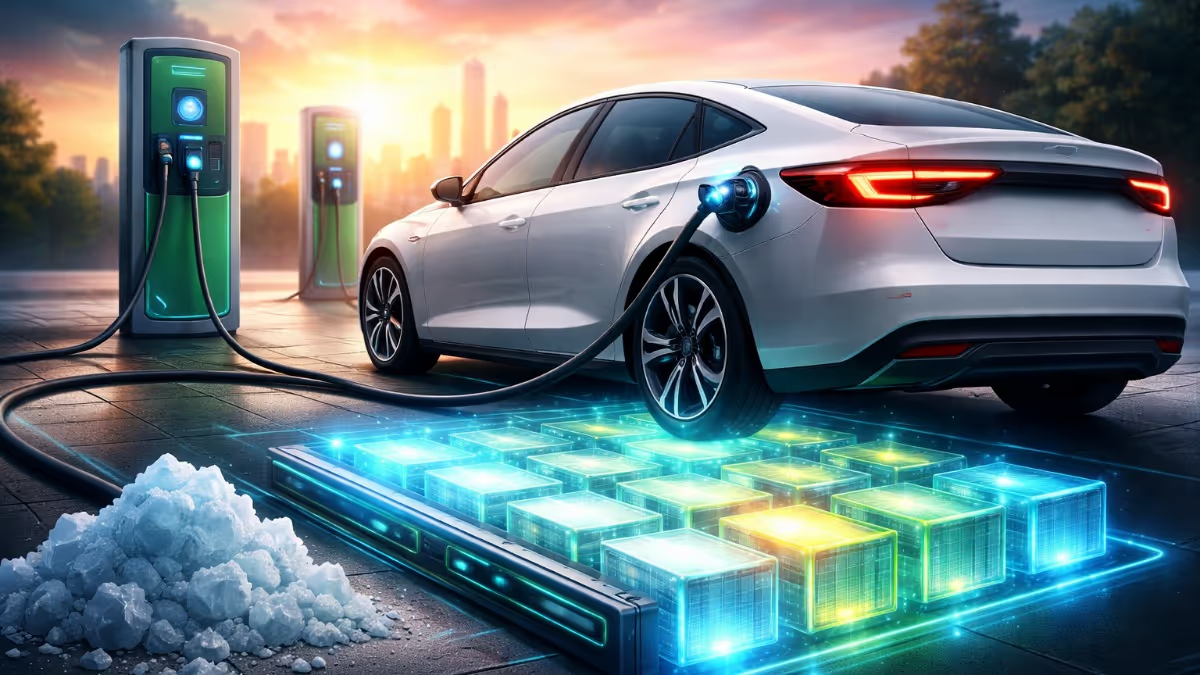
New Delhi: A major breakthrough in electric vehicle (EV) technology could soon address one of the biggest challenges faced by users—charging time and range. Chinese automaker BAIC has announced significant progress in developing next-generation sodium-ion battery technology.
⚡ What’s the Breakthrough?
According to the company’s research division, BAIC has developed a prototype sodium-ion battery with an energy density of 170 Wh/kg. The standout feature is its 4C fast-charging capability, allowing the battery to fully charge in just 11 minutes under test conditions.
While real-world charging times may vary, this development signals a potential leap forward in making EVs more practical and convenient.
🌡️ Designed for Extreme Conditions
The new battery is engineered to operate in a wide temperature range—from -40°C to 60°C. Impressively, it retains around 92% capacity even at -20°C, making it highly effective in cold climates.
Thermal testing also showed stability at temperatures up to 200°C, highlighting improved safety and durability.
🔋 Part of a Larger Battery Strategy
This innovation is part of BAIC’s “Aurora Battery Program,” which includes:
-
Sodium-ion batteries
-
Lithium-ion batteries
-
Solid-state batteries
The company has also completed validation for mass production of prismatic sodium-ion cells.
🚗 Why Sodium-Ion Matters
Compared to traditional Lithium-ion battery systems, sodium-ion batteries offer several advantages:
-
Lower cost due to easily available raw materials
-
Better performance in cold weather
-
Reduced dependence on scarce resources
However, they currently lag behind lithium-ion batteries in terms of energy density.
🏭 Industry-Wide Momentum
BAIC has filed around 20 patents related to this technology, covering materials, cell design, and manufacturing processes. Other Chinese companies are also rapidly advancing in this space.
In February 2026, Changan Automobile and CATL unveiled the first mass-produced sodium-ion EV, featuring a 45 kWh battery with a claimed range of over 400 km. The vehicle is expected to hit the market by mid-2026.
🔍 What’s Next?
Although BAIC has not yet announced a commercial launch timeline, the technology is currently in the pre-commercial stage. If successfully scaled, it could mark the beginning of a new era in EV adoption—making electric cars faster to charge, more affordable, and suitable for a wider range of environments.