How Amit Shah Wrote A New Political Grammar By Reframing The RSS Debate

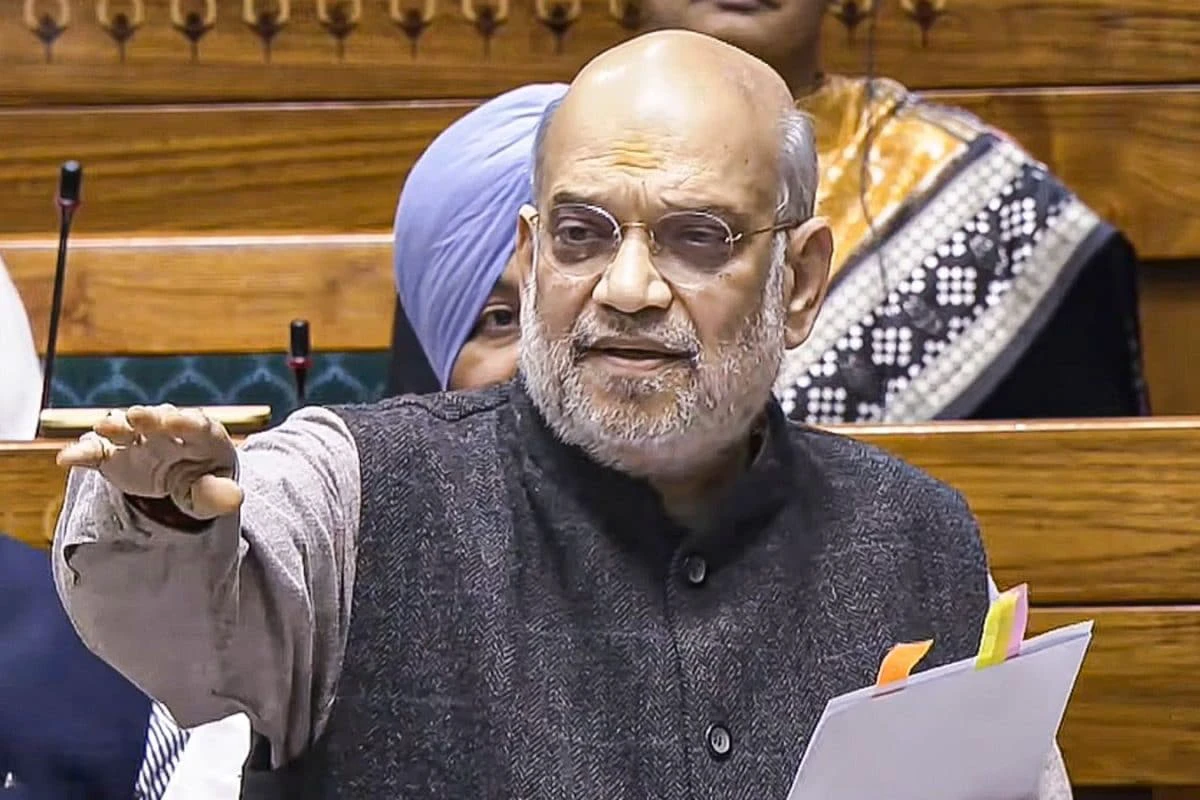
Union Home Minister Amit Shah’s sharp rebuttal in the Lok Sabha this week to Rahul Gandhi’s criticism of the Rashtriya Swayamsevak Sangh (RSS) was not merely a routine parliamentary exchange.
Shah said that the Congress has repeatedly tried to derive political mileage by targeting the RSS, but the people of the country have made it abundantly clear through their votes that those who adhere to the RSS ideology are the ones governing the nation today-and that this has happened not by anyone’s benevolence, but through a democratic mandate.
Shah’s strong remarks signal a deeper shift in Indian polity where the RSS has been the punching bag for most political parties, especially the Congress. Any association with the RSS had been categorised as a ‘liability’. A cartel of political parties and non-governmental organisations, backed by biased academia, created an ecosystem where the RSS was equated with Hindu orthodoxy and communalism.
Collapse of a Manufactured Moral High Ground
The moral high ground that this ecosystem had painstakingly created was based on a platform of lies and misinformation campaigns. This platform was demolished by Shah in his speech as he asserted that both he and the Prime Minister belonged to the RSS, whose philosophy is to make supreme sacrifice for nation building.
The old political idiom created by the Congress and the Left through academia, media and civil society demonised and caricatured the RSS and its ideological mentees-the Bharatiya Jana Sangh and its successor, the Bharatiya Janata Party. This political witch hunt led to three bans on the RSS-1948, 1975 and 1992-after Independence, the coining of the term ‘Saffron Terror’ during the UPA government, and conspiracies to target RSS functionaries with false charges. The Congress-Left ecosystem, backed by some regional outfits, also portrayed the RSS as a proxy for everything regressive in Indian society.
New Political Grammar
What Shah did in his speech was to establish a new political grammar by demolishing the platform of lies and misinformation against the RSS. He also inverted the Congress-Left moral architecture by associating the RSS with whatever is best for the country.
This was a significant intervention as opponents of the RSS have long taken advantage of the fact that it does not believe in countering statements of its critics. Instead, it focuses on grassroots work, with organisation of society as its primary mission. It considers even its critics as part of society and holds the belief that a day will come when they too will join the RSS. This has happened in the past.
Noted socialist leader Jai Prakash Narayan was once a fierce critic of the RSS. In 1975, he said, “If RSS is a fascist, I am also a fascist.” He later visited an RSS training camp in Patna on 3 November 1977, where he said in his speech:
“Sangh (RSS) is a revolutionary organisation and right now there is no other organisation in the country which comes even close to it… (it) alone has the capacity to transform society, end casteism and wipe the tears from the eyes of the poor. Its very name is ‘rashtriya’, which is national. I am not saying this to flatter you. I believe you have a historic role to play… I have great expectations from this revolutionary organisation which has taken up the challenge of creating a new India.”
Democratic Mandate over Dynastic Entitlement
The deeper implication of Shah’s statement is its rejection of a dynastic culture that reeks of inherited political entitlement. He categorically stated that it is the people of the country who have elected this government, whose Prime Minister and Home Minister are part of the RSS. This was not the outcome of ‘political charity’ but a democratic mandate of 1.4 billion people.
The inherent message is clear: the RSS represents the civilisational values driving present-day Indian society. The propaganda against it has been rejected by the masses, a reality reflected in electoral outcomes.
Critics may argue that electoral victories cannot be a reason to let an ideology escape scrutiny. That is true. But have the Congress, the Left and other detractors of the RSS ever tried to engage with it in an honest ideological debate? Instead, they have raised false alarms, twisted facts, created disinformation-based toolkits and manipulated academia, media and public discourse.
Prime Minister Narendra Modi spoke about the RSS from the ramparts of the Red Fort in his Independence Day speech in 2025, congratulating it on entering its centenary year. Now, the union home minister has delivered a blunt riposte to RSS detractors from the floor of Parliament itself. This is one of the defining moments in India’s civilisational discourse in the new millennium that would remain incomplete without recognising the contribution of the RSS.